A research team composed of experts from the U.S. Department of Energy’s Fermilab, the California Institute of Technology, and NASA’s Jet Propulsion Laboratory has announced a major breakthrough in quantum sensing. They have developed a Superconducting Microstrip Single-Photon Detector (SMSPD), a new quantum sensor that significantly enhances the spatial and temporal precision of particle detection in high-energy physics experiments.
The SMSPD underwent its first charged particle beam test at Fermilab, where it achieved dual milestones in resolution — both in space and time. These results mark a substantial step forward in tracking the behavior of particles in complex experimental setups. The findings have been published in the Journal of Instrumentation (DOI: 10.1088/1748-0221/20/03/P03001), signaling the sensor’s readiness for broader scientific applications.
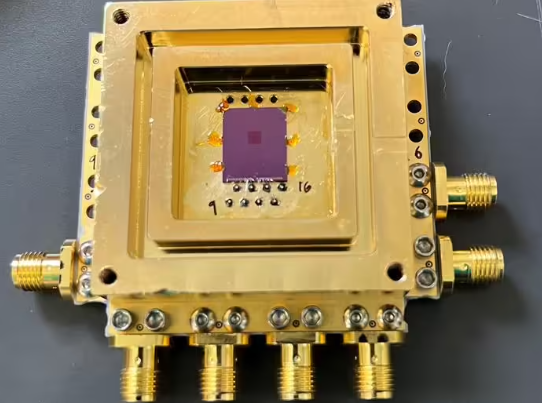
SMSPD is similar in concept to superconducting nanowire single-photon detectors (SNSPDs), which have been employed in quantum networks and astronomy. However, the SMSPD offers a larger detection area capable of capturing more particle flux, making it especially suitable for particle physics environments. Notably, the device succeeded in detecting charged particle beams—an ability that distinguishes it from existing detectors used in other quantum applications.
During testing, the sensor was exposed to high-energy proton, electron, and pion beams. The results demonstrated not only high detection efficiency but also the ability to accurately track particle movement through both space and time. This capability is essential for analyzing the cascade of particles produced in high-speed collisions, aiding researchers in uncovering the mechanisms of those collisions and identifying potential new physics phenomena.
Technology holds promise for integration into future large-scale scientific projects, including the Future Circular Collider (FCC) and proposed muon colliders, where accurate real-time tracking of millions of collision events per second is required. Additionally, the detector’s precision may benefit initiatives in quantum networking, such as the INQNET project, and even deep-space communication, where sensitive photon detection is essential.
Because of its enhanced spatial and temporal capabilities, the SMSPD is described by its developers as a “four-dimensional sensor.” As project lead and Fermilab scientist Cristián Peña explains, tracking particles in high-energy experiments is comparable to identifying a suspect in a crowded station: it requires both high-resolution imagery and rapid-frame-rate capture. Without either, a target can easily vanish in the noise.

According to Caltech physics professor Maria Spiropulu, particle collider technologies will undergo a fundamental transformation in the coming decades, with increases in both energy and intensity. She emphasizes that quantum sensors like SMSPD will play a key role in this evolution, offering new possibilities in dark matter detection and the exploration of the origins of space and time.
This development represents a convergence of quantum technology and particle physics, opening the door to new levels of measurement precision and scientific discovery. As these domains continue to integrate, tools like the SMSPD will be essential in pushing the frontiers of fundamental research.
 0







 Login/Register

 BOM
 Cart