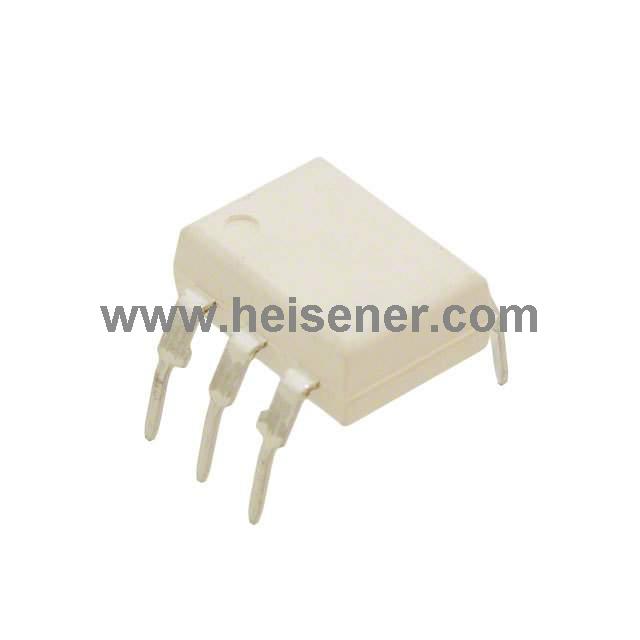
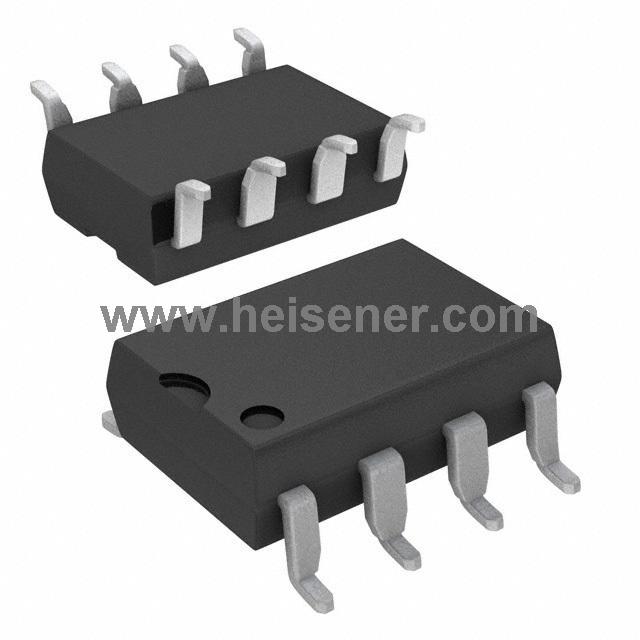
MOC3023 Basics
The MOC3023 is an optically isolated triac driver, primarily used for controlling AC loads. It integrates an infrared light-emitting diode (LED) and a light-sensitive triac trigger inside its package. When a forward current drives the input LED, it emits light that activates the light-sensitive triac on the output side, allowing current to flow and enabling isolation-based control of external AC circuits.
Its working principle is based on optical isolation. When current is applied to the input, the LED emits light, which in turn triggers the light-sensitive triac into conduction. This can either drive a power triac in the main AC circuit or directly control an AC load. Since the signal transmission occurs through light with no electrical connection between input and output, it effectively isolates high- and low-voltage sections, improving system safety and noise immunity. The MOC3023 is commonly used in applications such as dimmers, motor control, and AC switches.
MOC3023 Pinout
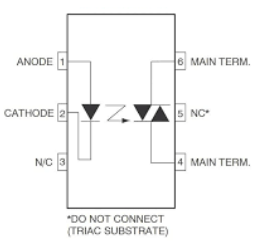
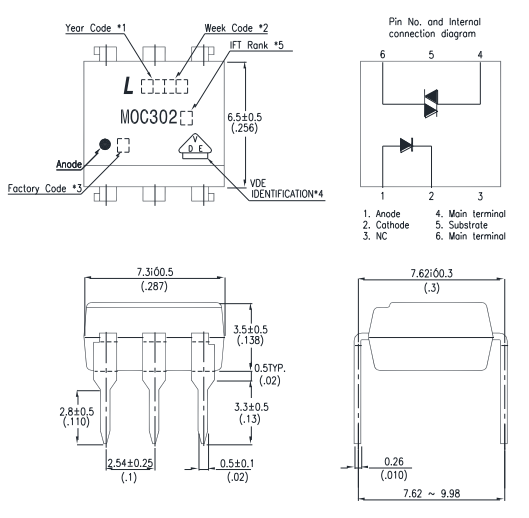
Anode (Pin 1) – Connected to the positive side of the input control signal to drive the internal LED.
Cathode (Pin 2) – Connected to the negative side of the control signal (ground side) for the internal LED.
N/C (Pin 3) – Not connected internally; typically left floating.
Main Terminal (Pin 4) – One terminal of the internal light-sensitive triac (output side).
NC* (Pin 5) – Not connected (functionally unused).
Main Terminal (Pin 6) – The other terminal of the output triac.
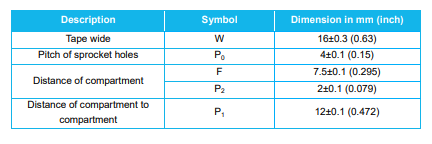
MOC3023 Typing Dimensions

MOC3023 Specification
| Parameter |
Specification |
| Package Type |
6-pin DIP |
| Isolation Voltage |
5000Vrms |
| Forward Voltage |
1.15V |
| LED Trigger Current |
5 mA |
| Peak Off-State Voltage |
400 V |
| DC Forward Current |
50 mA |
| Hold Current |
250µA (Typ) |
| Static dV/dt (Min) |
1kV/µs |
| Turn-On Time |
100 µs (typical) |
| Operating Temperature |
–40°C to +100°C |
| Approval Agency |
CQC, CSA, TUV, UL, VDE |
MOC3023 Features
Isolation voltage between input and output Viso: 5,000Vms
6pin DIP photocoupler, triac driver output
High repetitive peak off-state voltage VDRM : Min. 400V
High critical rate of rise of off-state voltage( dV/dt : MIN. 1000V /us)
Dual-in-line package
Safety approval
UL 1577, Cert. No.E113898
CSA CA5A, Cert. No. 1020087 (CA 91533-1)
FIMKO EN/IEC 60950-1, EN/IEC 60065; Cert. No.NCS/FI 224426 M3
VDE DIN EN60747-5-2, Cert. No. 40015248
CQC GB4943.1-2011/GB8898-2011
ROHS Compliance
All materials be used in device are followed EU RoHS directive (Nlo.2002/95/EC).
MSL class1
MOC3023 Applications
AC Motor Drives
AC Motor Starters
E.M. Contactors
Lighting Controls
Solenoid/Valve Controls
Solid State Relays
Static Power Switches
Temperature Controls
MOC3023 Package Dimensions
The MOC3023 features a standard 6-pin DIP (Dual In-line Package), making it easy to install on common through-hole PCB designs. This package offers generous pin spacing, which enhances high-voltage isolation, making it ideal for applications requiring strong insulation and safety, such as industrial control and power management systems.
MOC3023 Equivalents
Equivalent models in the same series as the MOC3023 include the MOC3020, MOC3021, MOC3022, and MOC3024. These devices share similar functionality and the same DIP-6 package, all being optically isolated triac drivers. The primary difference lies in their required trigger currents. Depending on the specific application requirements, an appropriate alternative can be selected.
How to Use MOC3023?
First, connect the control signal to the input side of the MOC3023 (pin 1 as anode, pin 2 as cathode). When the internal LED is forward biased and emits light, it activates the internal light-sensitive triac (phototriac), which then conducts. This, in turn, triggers the main circuit connected to the output terminals (pins 4 and 6), allowing it to drive an external triac or AC load directly.
The input and output are optically isolated, ensuring safe separation between the low-voltage control side and the high-voltage load side. It is recommended to add a current-limiting resistor in series on the input side, and on the output side, use the MOC3023 in conjunction with a triac and consider adding a snubber circuit to suppress voltage spikes.
FAQs
What is the primary function of the MOC3023?
The MOC3023 is an opto-isolated bidirectional triac driver designed to control AC loads. It uses an internal LED to trigger a photonic triac, enabling safe isolation between low-voltage control circuits and high-voltage AC circuits.
What types of loads can the MOC3023 control?
The MOC3023 can control AC loads such as motors, lights, and other resistive or inductive loads by triggering external triacs (TRIACs) or similar components.
Can the MOC3023 be used in high-frequency circuits?
The MOC3023 is primarily used for AC switching applications and is not optimized for high-frequency switching. It is best suited for standard AC control circuits where the frequency is typically 50 or 60 Hz.
 0





 Login/Register

 BOM
 Cart